


A Swarm is a new kind of organization, made possible by available and affordable mass communication. Where it used to take hundreds of full-time employees to organize 100,000 people, today that can be done — and is done — by somebody in their spare time from their kitchen.
There are many misconceptions about what a Swarm is. Let’s begin by dispelling what it is not.
It is not an amorphous cloud of equals, where nobody gets any decision power. While this would be an ideal society to some, it is not a Swarm.
Neither is it a traditional hierarchical organization where commands are issued top-down and people are expected to follow them. A Swarm may look like this from the outside, but that’s not what it is.
Rather, it is a scaffolding set up by a few individuals that enable tens of thousands of people to cooperate on a common goal in their life. These tens of thousands are usually vastly diverse and come from all walks of life, but share one common goal. The scaffolding set up by one or a few individuals allow these thousands of people to form a Swarm around it and start changing the world together.
This scaffolding doesn’t appear very complex. At its simplest, it is just a means to communicate and discuss the issues the Swarm wants to make a change on, like a forum on a server. The complexity comes with the meritocracy that makes up how the Swarm operates and decides on courses of action as an organism.
As all the people in the Swarm are volunteers — they are there because they think the Swarm can be a vehicle for change in an area they care about — the only way to lead is by inspiring others through action. The founder of the Swarm has a great deal of initial influence in this manner, but he or she is far from the only one. In a typical Swarm, you will find that people inspire one another across all levels and all geographies, with the only common factor being the overall goals of the Swarm that every particular individual chooses to follow.
Significantly, focus in the Swarm is always on what everybody can do, and never what people cannot or must do.
This sets it sharply apart from a traditional corporation or democratic institution, which focuses sharply on what people must do and what bounds and limits they are confined to. This difference is part of why a Swarm can be so effective: everybody can find something they like to do all the time off a suggested palette that furthers the Swarm’s goals, and there is nobody there to tell them how things may not be done.
In a Swarm, nobody gets to tell anybody else what to do. (People can take on roles and deliverables voluntarily, though.)
Rather, people inspire one another. There are no report lines among activists. As everybody communicates with everybody else all the time, successful projects quickly create ripples. Less successful ones causes the Swarm to learn and move on, with no fingers pointed.
If you want leadership in a Swarm, you stand up and say “I’m going to do X, because I think it will accomplish Y. Anybody who wants to join me in doing X is more than welcome.” Anybody in the Swarm can stand up and say this, and everybody is encouraged to. This quickly creates an informal but tremendously strong leadership structure where people seek out roles that maximize their impact in furthering the Swarm’s goals — all happening organically without central planning and organization charts.
The only people who deviate from this and take on formal deliverables are the ones upholding the scaffolding of the Swarm — being points of contact from media and other external organizations that work in a traditional way. Because of this, a Swarm may sometimes look like a traditional organization. But there is a key difference: it looks like a traditional organization from the outside because it chooses to; because the Swarm is more efficient in interfacing with legacy-type organizations that way. Not because it actually operates that way.
At the bottom line, what sets a Swarm apart from traditional organizations is its blinding speed of operation, its next-to-nothing operating costs, and its large number of very devoted volunteers. Traditional corporations and democratic institutions appear to work at glacial speeds from the inside of a Swarm. That’s also why a Swarm can change the world: it runs in circles around traditional organizations, in terms of quality and quantity of work, as well as in resource efficiency.
This book will teach you every step of constructing the necessary scaffolding and building a successful Swarm around it.
EXCERPT FROM UPCOMING BOOK
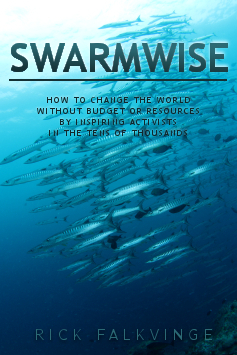
This is a draft part of the upcoming book Swarmwise, due early 2012. It is an instruction manual for recruiting and leading tens of thousands of activists on a mission to change the world for the better, without having access to money, resources, or fame. The book is based on Falkvinge’s experiences in leading the Swedish Pirate Party into the European Parliament, starting from nothing, and covers all aspects of leading a swarm of activists into mainstream success.





Good,,,,,,,,,,
“This quickly creates an informal but tremendously strong leadership structure where people seek out roles that maximize their impact on the Swarm’s goals”
Personal power/influence is the main driver for the individual in the swarm? really?
Sounds a bit old school to me. 😉
Personal power/influence is the main driver for the individual in the swarm? really?
No, the main driver for an invididual contributor is a resonance between the Swarm’s goals and the individual’s goals, and that the individual realizes that a unit of work spent in the Swarm has a much larger effect than a unit of work spent as an individual.
I’m just reminded why it’s great to publish parts of an upcoming book like this. You can fix any mistakes and misconceptions before it goes to print, as you get immediate feedback. Great!
Well that’s more like it!
You could interpret the “… seek out roles that maximize their impact on the Swarm’s goals” in two ways.
impacting what the goal of the swarm should be.
or
impacting the common goal in itself.
I’m glad it was the latter. Since I did’nt really agree with the former. 🙂
Kevin Carson is also adhering to Eric S. Raymond’s “Release early, release often” advice in writing “Desktop Regulatory State” http://desktopregulatorystate.wordpress.com/
Is there a similar location where the Swarm can read the current draft of Swarmwise and give more feedback? Seems fitting to allow the Swarm to contribute more to its own biography 😉
Thanks for the excerpt, Rick. Will it be available in the US when it ships world-wide or will we need to get it from the UK?
Hi James,
At a minimum, it will be available on Amazon.com and The Pirate Bay.
Cheers,
Rick.
“At a minimum, it will be available on Amazon.com and The Pirate Bay.”
Here’s hoping you’ll be doing a Paulo Cuelho then. 🙂
[…] theory looks at how action can be organised through the Hivemind. It’s explained well by Rick Falkvinge, founder of the Swedish Pirate Party: A swarm “…is a scaffolding set up by […]
[…] It would be a government by the swarm. […]
[…] Excerpted from Rick Falkvinge: […]
In other words, you’re describing an ad-hocracy (https://secure.wikimedia.org/wikipedia/en/wiki/Adhocracy), a model of action that’s become very prevalent in some circles in the past couple of years.
[…] see this in how the swarms are overtaking the old, centralized, rule bound structures. People cooperate in the tens of […]
[…] What is a Swarm. […]
[…] /2011/08/01/swarmwise-what-is-a-swarm Tweet (function() { var s = document.createElement('SCRIPT'), s1 = […]
[…] (1) Rick Falkvinge, „Swarmwise: What is a Swarm?“, 8. Januar 2001, falkvinge.net/2011/08/01/swarmwise-what-is-a-swarm. […]
[…] en català. Versión en castellano. English version. Original: Swarmwise: What is a swarm? escrit per Rick Falkvinge, fundador del Partit Pirata […]
[…] en català. Versión en castellano. English version. Original: Swarmwise: What is a swarm? escrit per Rick Falkvinge, fundador del Partit Pirata […]
[…] Rick Falkvinge suggests that Swarm Leadership is a scaffolding set up by a few individuals that enable thousands of people from diverse backgrounds to cooperate on a common goal in their lives and changing the world together. If you want leadership in a Swarm, you stand up and say “I’m going to do X, because I think it will accomplish Y. Anybody who wants to join me in doing X is more than welcome.” Anybody in the Swarm can stand up and say this, and everybody is encouraged to. This quickly creates an informal but tremendously strong leadership structure where people seek out roles that maximize their impact on the Swarm’s goals — all happening organically without central planning and organization charts. […]
Are there any news when the book will be published?
The rough draft is ready. I’ll know a release date window (plus/minus a few weeks) next week, hopefully.
Rick
[…] Fonte: /2011/08/01/swarmwise-what-is-a-swarm […]
Excellent weblog right here! Also your web site quite a bit up very fast!
What web host are you the usage of? Can I get your affiliate hyperlink in your host?
I wish my web site loaded up as quickly as yours lol
Thanks for the marvelous posting! I seriously enjoyed reading
it, you can be a great author. I wilpl ensure that I bookmark your
blog and will eventually come back in the foreseeable
future. I want to encourage you to definitely continue your grea posts, have a nice
weekend!
[…] of a phenomenon called the “Swarm”. Rick Falkvinge, founder of the first Pirate Party describes the Swarm as a new style of organizing. He explains how this differs both from an egalitarian way […]
I know this web page provides quality dependent artices and other material, iis there any other siute which offers such data
in quality?